BeachWhisperer: DPA against nRF52840 (Arm CryptoCell 310) Hardware AES

My DPA Dog-friend (Bergen) is my faithful research assistant out here.
There is a not-too-untrue caricature of hardware hackers as being people in a dark lab, surrounded by test equipment and blinking lights. Unlike software attacks, with hardware you’ve got to be “near the equipment”. Or at least, that was what I always thought.
Over late summer/fall I gave Claude access to a ChipWhisperer-Husky with a nRF52840 target. I was curious to see if it could attack one of the the nRF52840 AES cores, specifically the Arm CryptoCell 310 AES core.
Around this time E-Shard published a successful attack as well, although this was’t used as input (and we ended up with an attack from the other end they looked at interestingly, described below).
At the same time it was quite a nice day out - so I’d like to go enjoy some time outside. Using Claude remote control I decided to kick off the attack and from there let it work semi-autonomously. From my phone I could request power traces and do other things that one cannot easily code from a mobile phone.
This gives me the “remote” attack - which is not the case that the attack involved remote measurements, which is what we normally call remote. Instead I was remotely connected to the bench (in this case, with limited access via a mobile phone). I should be clear - I’m misusing ‘remote’ as a joke here, don’t start calling this a ‘remote attack’
In total from my first prompt until a successful attack was about nine hours, and I had about 13 prompts in-between. This successfully broke both nRF AES accelerators with almost no special knowledge input from me, giving an interesting snapshot into the future of security research.
Setup and Prompting
I plugged in my ChipWhisperer-Husky with a nRF52840 board from a drawer that I was pretty sure worked (I use a lot of “R&D” models so here my husky has no enclosure):
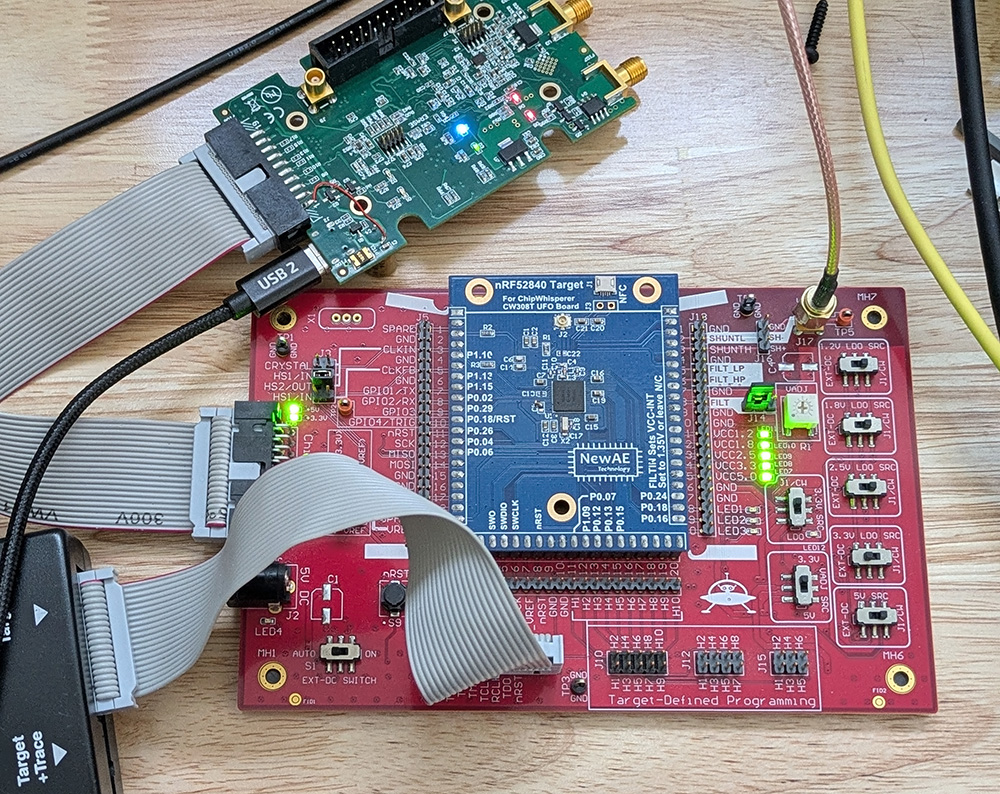
The nRF52840 Target of unknown providence.
I started with an empty folder. I had run a few other attacks before with Claude, but I figured I’d like it deal with most of the setup, so kick off the session with my initial prompt:
Attached is a chipwhisperer-husky with an nrf52840 target - there is a HAL in the CW folder. A J-Trace is attached for programming. Can you get the hardware AES running and perform a SCA attack on it?
There was previous examples in ../f5_hwc and ../sca_toolkit of attacking chipwhisperer targets. ChipWhisperer is available at C:\ChipWhisperer6 .
The previous project had a batched segmented capture mode (that Claude also wrote) that eventually got me from 40 encryptions/second to 36,000 traces/second. It did this by running a pseudorandom generator on the target & not sending back any plain/ciphertext, but checks every “so often” that things are still in sync.
Thirteen prompts over the whole day, most of them one line, sometimes just minor pointers to the setup. e.g., I had a (typos-included) prompt to point it to the nRF HAL:
There is a hal int he chipwhisperer-extra submodule of the hal
Here is every one of them, pulled back out of the session transcript. A few were typed while it was still working and sat queued until it came up for air:
| time | prompt |
|---|---|
| 10:52 | the opening prompt, above |
| 10:54 | There is a hal int he chipwhisperer-extra submodule of the hal |
| 11:32 | I can remove some of the caps first |
| 11:34 | I removed the target |
| 11:35 | taget is back sans C5 |
| 12:23 | Can you make a plot for the other AES core of traces/key rank? |
| 12:36 | For bigger captures use C:\dev\nrf_traces instead. Do a very deep dive on the CC310, try to figure out the structure first and anything else about it. Consider using a higher capture ADC clock if useful. |
| 14:20 | Can you try filters on the data too? Use the covariance trick to sweep filters. |
| 15:01 | how long will the filter runs take roughly? |
| 15:02 | yes, kick it off |
| 16:14 | Are there more hardware tests you can do? What is the effect of different sampling rates, out changing the phase adjustment? Focus on the cc310 |
| 17:28 | what is the status? |
| 19:43 | ok, can you ensure everything is updated in docs and I’ll shut this session down. |
The only two with any technical input were at 12:36 and 14:20. So in terms of “expertise required” it still felt low.
Bring-up
Programming worked but the serial link was dead. I had grabbed a random nRF52840 board I had lying around - I couldn’t remember if it actually worked, so I would have otherwise had to go debug it. But Claude came back with:
Firmware is alive - PC is inside
nrf_serial_read, waiting for a character. So the issue is the UART link. Let me probe it raw.
Then it mapped the pins the only honest way: drive each ChipWhisperer TIO pin in turn, read the nRF’s GPIO.IN back over SWD, and disambiguate
the floating ones. TIO1, TIO3 and TIO4 answered. TIO2 never did, which is the net the stock HAL puts UART RX on. It then went and read the board
schematic PDF to confirm the net, and called it:
TIO2/GPIO2 is dead at the physical level (the Husky configures identically for tio1/3/4 and those work). I’ll work around it by moving the target’s UART RX to GPIO3.
So this particular board has an open circuit on GPIO2 and I didn’t know. Amazingly it just “wrote around” the hardware problem with almost nothing from me.
Capacitor Mods
The initial capture showed no real AES signal. Rather than guess, it read the schematic for the board. I had designed this board to have a nice SCA measurement path, but actually Claude didn’t “know” what was in my mind, although basically “figured out” that the caps were designed to simplify DPA measurements (what it means to “figure out” we can argue, for now lets just brush over that):
Remove C5 (1 µF) first. Per the schematic netlist, C5 is on the
SHUNTLnet - i.e. directly across DEC4/DEC6, on the chip side of the shunt. It shunts exactly the AC core current we’re trying to measure through R1. It is the one cap that is actively cancelling our signal.
- Keep C1 (2.2 µF) and C2 (100 n) - these are on
SHUNTH, the far side of the shunt. They’re the reservoir supplying the transient current through R1. Removing them would make things worse.- Keep C6, C14 (100 p) - those are the CLKIN→XC1 path we depend on for the clock.
I did indeed have C5 on the board still, so removed that, and gain required changed from about from 50 dB down to 12 dB to get a good signal.
The other thing standing between us and the cipher was software: the CPU sits in a
while(!EVENTS_ENDECB) polling loop for the whole encryption and drowns a 40-cycle AES. Again, this wasn’t my direction but it did figure out that it needs to sleep the core instead of
a busy-wait loop to reduce noise. It even did some debugging to figure out why it didn’t work first time:
Confirmed - WFE hangs. The cause: with the ECB IRQ disabled in the NVIC, a pending interrupt doesn’t generate a wake-up event unless
SCR.SEVONPENDis set.
With the CPU asleep the round structure is fairly clear, showing ten rounds at 4 cycles each, then EasyDMA writing the ciphertext out one byte per 4 cycles (a few rounds don’t show up due to noise):
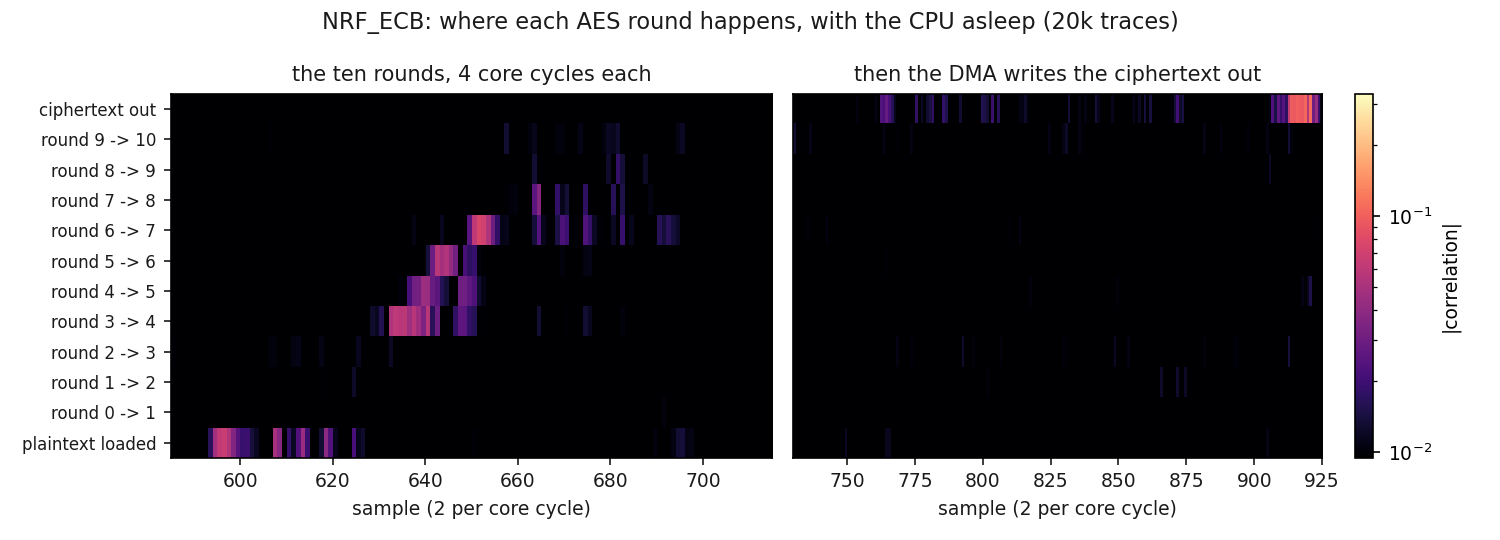
Every AES round transition located in time, with the CPU asleep. The staircase is rounds 3-4 through 8-9; the first two and last two don’t clear the noise floor at 20k traces. Right panel is the same capture a hundred samples later, where EasyDMA pushes the ciphertext out one byte at a time.
At this point, we can do the rest from our phone somewhere outside our dark lab (such as the beach) and fix our Vitamin-D deficiency.
I should emphasize heavily: from here on the majority of work is done automatically - changing leakage points, filters, etc was mostly done at Claude’s own impetus with minor prompting. All figures in the post are generated via scripts from Claude. This post is mostly me + Claude (LLM generated text reads weirdly I find, so it’s mostly me cleaning up or fixing stuff).
The easy core: NRF_ECB
NRF_ECB is the AES-128 block the BLE stack uses: 486 core cycles a block, of which the ten
rounds are only about 40. Here it is next to the more interesting (CC310) core on the same time axis (NB: This figure was generated with knowledge of the leakage - it cannot be
known at “this point in time” if you are reading the work linearily).
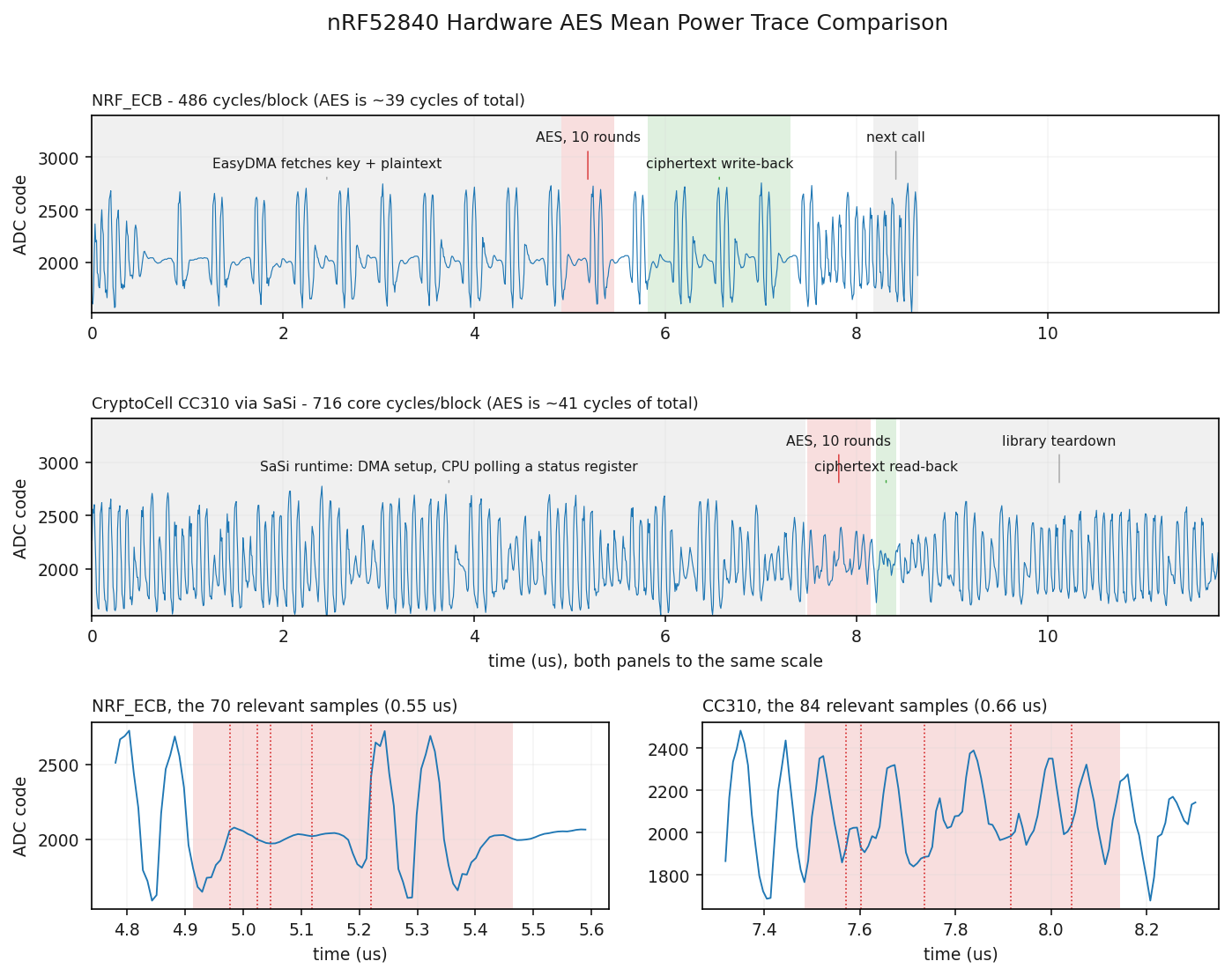
Both cores with the AES of each zoomed below. Rhe cipher takes about the same time on both, roughly 40 core cycles, so the 486 against 716 per block is wrapper rather than silicon. Every boundary comes out of a correlation or NICV profile, and the shaded bands (relevant samples) mark where leakage is measurable rather than the exact extent of the cipher, which is why the ECB band looks the narrower of the two. The dotted red lines in the zooms are measured round transitions, some never clear the noise floor at 20k traces so are not marked.
Its first-round attack on HW(pt ⊕ Sbox(pt⊕k)), and the core falls over completely: 16 of 16 key bytes
exactly right, full key rank 2^0, from 2 M traces, which is 90 seconds of capture at 23,000
traces/s. Crossing 2^32 (the point where you’d just enumerate the rest) takes 150-250k traces
depending on the key, about ten seconds of capture. Verified on three independent random keys.
Two names are about to keep coming up, so to get them out of the way: HW is Hamming weight,
the number of set bits in a byte. CPA correlates each trace sample against the Hamming weight of
the byte you’re guessing, which quietly assumes all eight bits of it cost the same power. LRA
drops that assumption and fits a weight per bit instead, nine numbers rather than one fixed
yardstick, so it is more honest about the leakage and more expensive in variance. Which of the
two is the better choice on a given core is not obvious at all, and getting that wrong is one of
the retractions further down.
The filter is doing real work there. Unfiltered CPA gets 13/16 and rank 2^32; subtract a local
moving average (bandpass4-14) and it’s 16/16 at 2^0. This will be described in more detail later.
CC310: First (failed) attempt
The other core is an Arm CryptoCell CC310, reached through Nordic’s SaSi runtime, 716 cycles a call, which as the figure above shows is nearly all wrapper. After it did a longer (500k) capture, it reported no success. Wanting to see for myself, I asked it from my phone to give me some graphs to satisfy my curiosity:
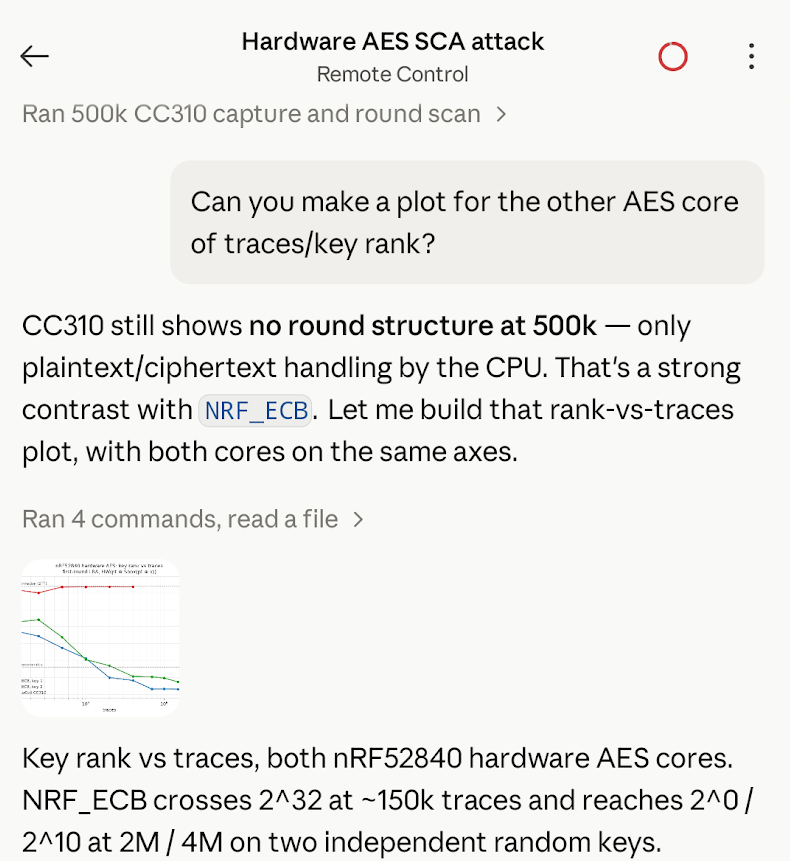
My first mobile query after kicking off from my computer, asking for some better graphics.
This showed no observable leakage. But leakage below the noise looks like no leakage, so I knew we could just go harder.
With the new capture method, we could capture millions of traces quickly. So the next goal was to tell it to kill my SSD and just go wild with captures. My next beach prompt was telling it to go ahead with a longer capture, at which point I picked back up from home (since the next step took a few hours, but without me):
My request for Claude to go harder. I didn’t provide real technical direction, just a vibe.
A few hours later it had come back with a successful attack, and I knew it would be possible to improve this (as it always is once you see some leakage):
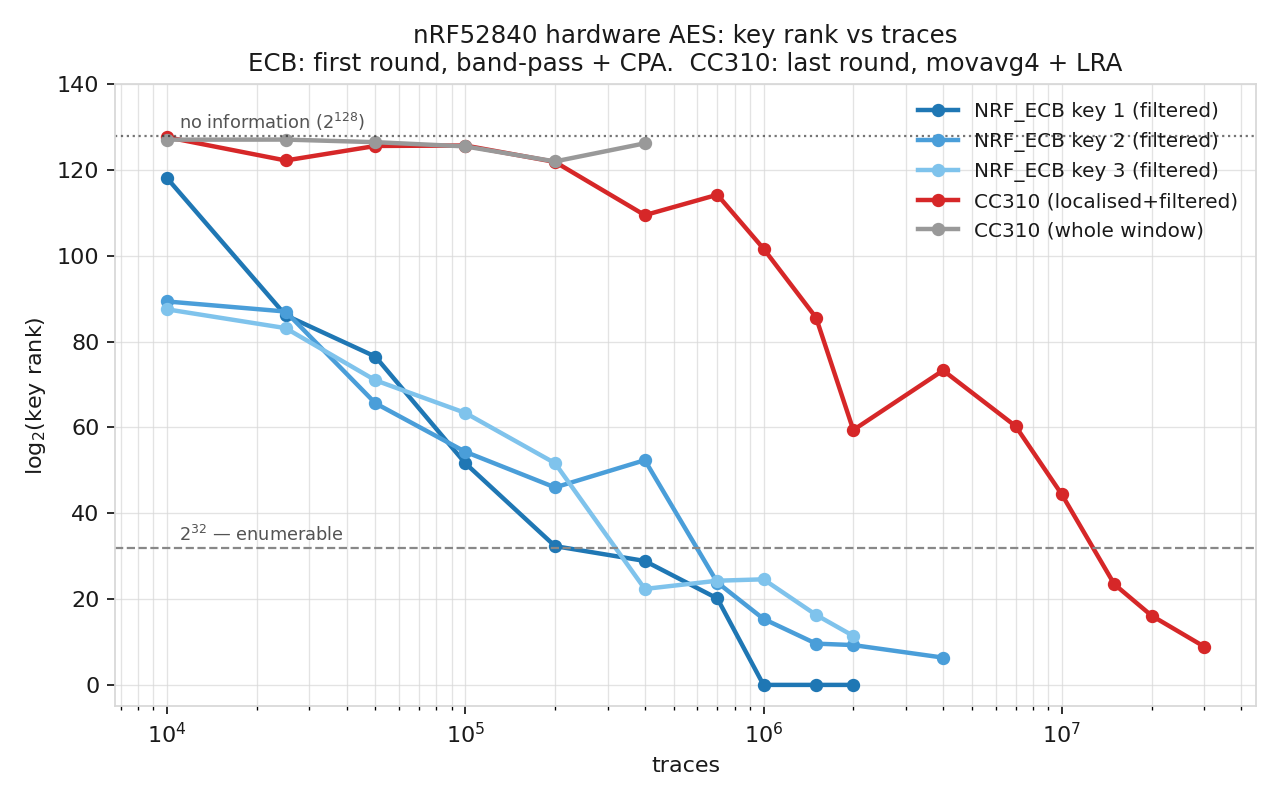
Both cores on the same axes. The grey curve is the CC310 attacked over the whole trigger window - pinned at 2^128, which is what failed at first.
The CC310’s AES is 6% of what we were capturing. Sweeping blocks-per-call gives
duration = 642 + 40.8 x blocks core cycles, so a single-block SaSi_AesBlock() call is 94%
library overhead: DMA setup and a status-register poll. The ECB core is no better on that
measure, about 40 cycles of cipher inside 486, it just has less wrapper to hide in and the
wrapper it does have is EasyDMA moving the key and the result rather than a CPU in a polling
loop. And at 500k traces the NICV floor sat
at 5.1e-4 while the round leakage is about 4e-4. Buried, not absent.
“We” (aka Claude) can make some nice figures for us on request, like showing where the leakage should become detectable:
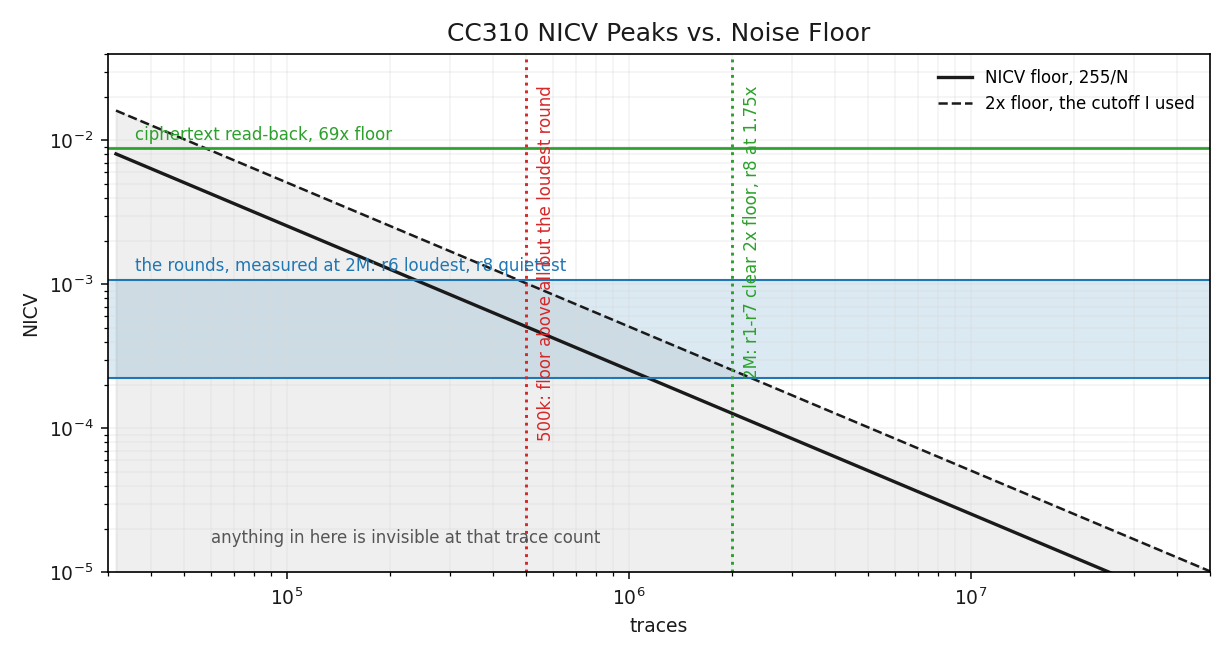
The floor for a 256-class NICV is 255/N, so it moves and the leakage doesn’t. The ten rounds aren’t one level but a band, 2.2e-4 to 1.08e-3 measured at 2 M, round 8 quietest and round 6 loudest. At 500k the floor sits above all but the loudest of them, which is the ’no measurable leakage’. At 2 M rounds 1 to 7 clear twice the floor, and round 8 at 1.75x so still reads as nothing.
Finding the cipher needed a detector that assumes nothing, since the whole question was whether it leaks at all. The trick that worked: encrypt n blocks in one call and look for where the mean trace stops agreeing with the n=1 mean.
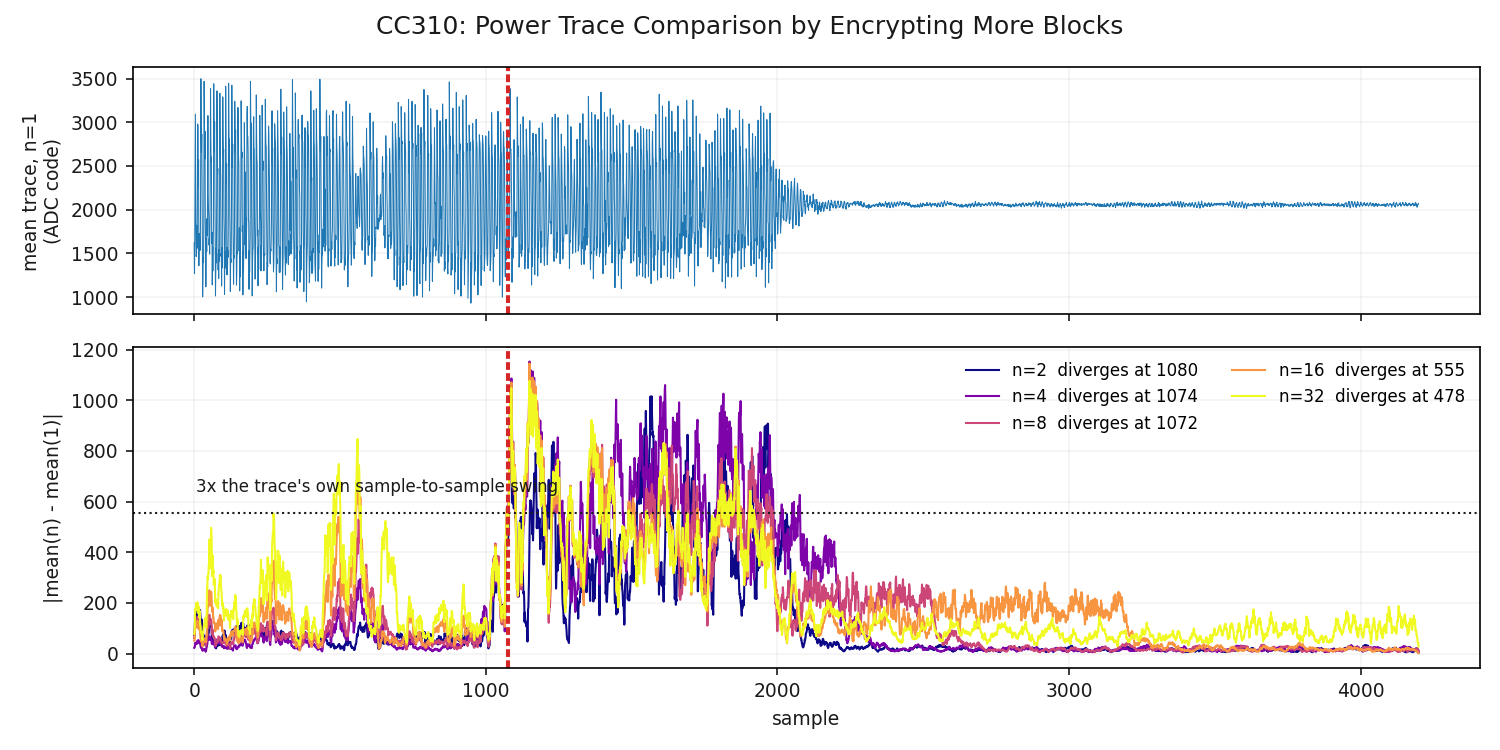
No leakage model, no key, no assumption about the cipher. mean(n=2) and mean(n=4) part company with mean(n=1) around sample 1030, which is where block one’s AES ends; the legend numbers are where each curve crosses the dotted threshold, which is deliberately blunt, so they land a little late. n=16 and n=32 diverge much earlier because the library’s DMA setup scales with buffer length, so only the small-n curves locate the cipher.
mean(n=2) and mean(n=4) both part company with mean(n=1) at about sample 1030, which is
where block 1’s AES ends. 82 samples long, so the AES sits at roughly 951-1033, immediately
before the ciphertext write-back. Don’t read more precision into that than it has: the exact
crossing depends on where you put the threshold, 1026 against a null taken from the library
setup and 1080 against the blunter one in the figure. Good enough to cut a 1500-sample window
down to about 150, which is all that was being asked of it.
That cut is also the reason any of the big captures were affordable. Throughput here is ADC samples coming off the Husky rather than anything the target does, about 2.6 M samples/s, so the trace rate is just that divided by however wide your window is. Measured both ways: the ECB capture ran 23,028 traces/s at 120 samples and the CC310 one 35,700 traces/s at 70, which is 2.76 and 2.50 M samples/s. Same number. Which makes the cost of not localising look like this:
| window | 30 M traces takes | on disk |
|---|---|---|
| 70 samples, round 9 only | 14 min | 5.2 GB |
| 350 samples, the localised window | 67 min | 21 GB |
| 1500 samples, the whole trigger window | 4.8 hours | 90 GB |
A 30 M capture over the whole window was never going to happen inside a nine-hour day, never mind five of them. Finding the cipher first is what turned that into fourteen minutes.
Re-run NICV on that window at 2 M traces and the rounds come out in order, about 5 core cycles each: r1 at sample 113, r3 at 134, r5 at 157, r6 and r7 at 173.
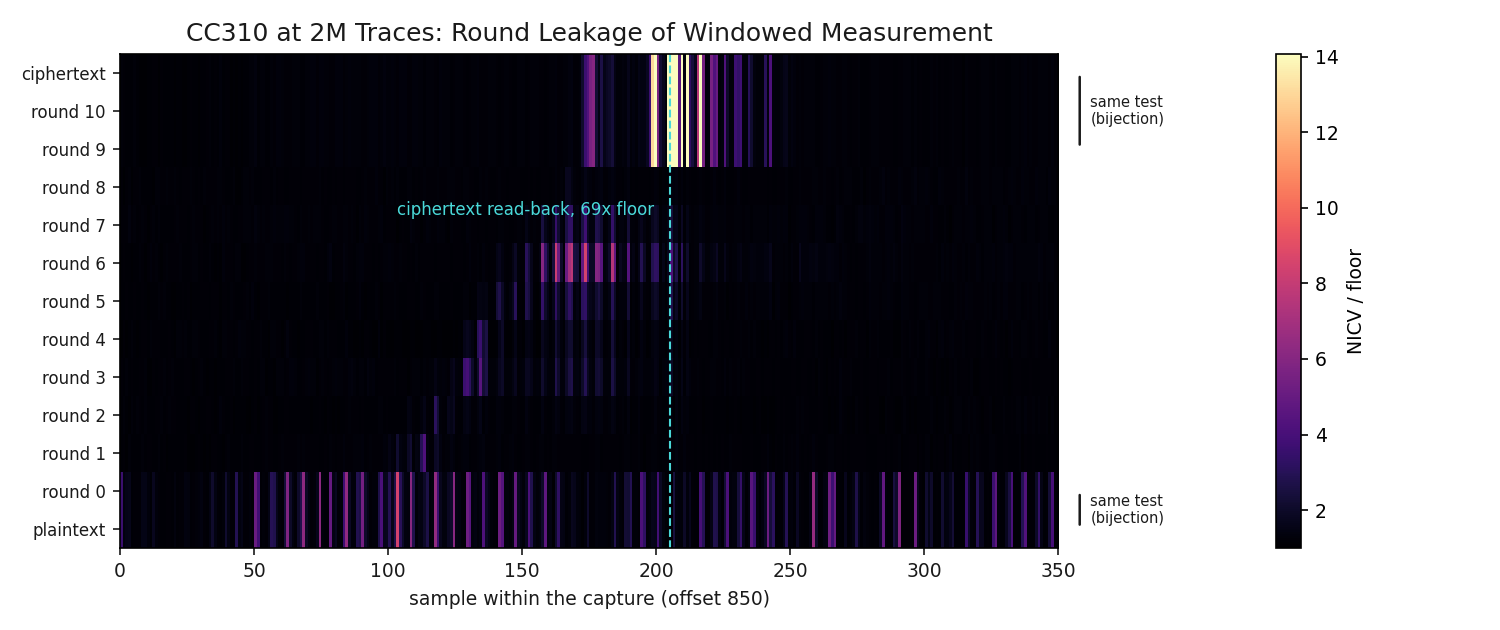
The CC310 leaks its internal state fine once you look in the right 6% of the window. Round 8 is blank because it only reaches 1.75x the floor. The bracketed rows are pairs NICV cannot tell apart at all.
Two cautions on reading the above: (1) NICV is invariant
under a per-byte bijection, so pt, pt ⊕ k and Sbox(pt ⊕ k) are literally the same test,
and so are r9, r10 and the ciphertext, which is what those brackets in the figure mark. And (2) a
fixed-vs-random TVLA t-test fails spectacularly here (|t| = 2425) without that being evidence
of a key-dependent leak at all, because with a fixed plaintext every intermediate is fixed too.
A common trap is that tjhe ciphertext write-back is 69x the NICV floor, and a
last-round hypothesis InvSbox(ct ⊕ h) correlates with raw ciphertext wherever it sits on the
bus, so a wrong candidate wins there and more traces don’t fix it. Here is a nice little
graph to prove that for you:
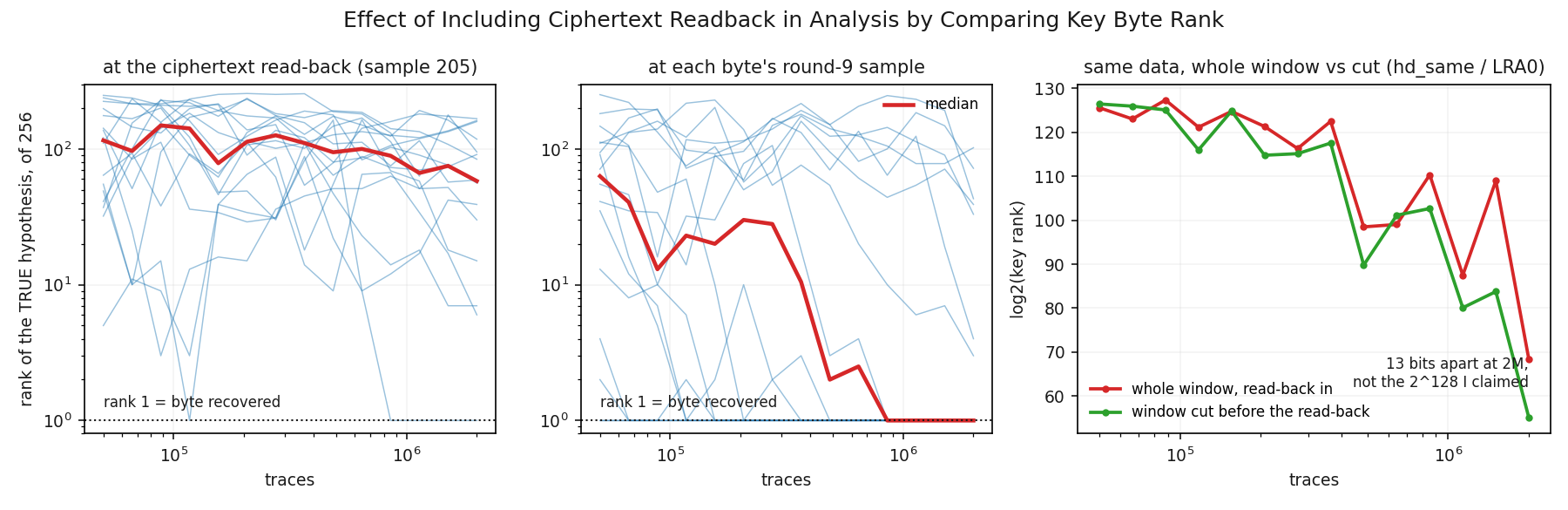
One thin line per key byte, bold line the median. At the round-9 sample the true hypothesis walks down to rank 1 and nine bytes land exactly. At the read-back it sits at median rank 58 of 256 after 2 M traces, having been 116 after 50k, which is no progress at all. Right-hand panel is the blind version: picking the window by margin instead of by knowing the key.
Over the whole 1500-sample trigger window, which is the grey curve further up, you get nothing. Over the localised 350-sample capture, leaving the read-back in costs you this:
| window, 2 M traces | bytes | log2(rank) |
|---|---|---|
| whole capture, read-back included | 8/16 | 68.3 |
| before the read-back (145:200) | 10/16 | 55.0 |
Same data, same model, 13 bits. From there it’s trace count and three knobs:
| step | bytes | log2(rank) |
|---|---|---|
| 30 M, window 40:53 unfiltered | 11/16 | 50.9 |
| 30 M, window 42:51 unfiltered | 13/16 | 14.5 |
| 30 M, window 40:53, bit-pair basis | 13/16 | 22.0 |
30 M, window 40:53 + movavg4 | 13/16 | 8.9 |
2^8.9 is about 480 candidates, which you sift against a single known plaintext/ciphertext pair in no time. So the CC310 goes too, at roughly 100x the cost of the ECB core. Note the first two rows: a three-sample change in the window changes about 36 bits of recovery.
The third row is one we looked at after the initial attack, and on this core it’s the biggest
knob of the three. LRA normally fits a weight per bit of the target byte, nine terms including
the constant. Let it fit all 28 pairwise products of those bits as well, 37 terms, and the same
unfiltered window drops from 2^50.9 to 2^22.0. A product term is energy that depends on two
bits being set together rather than on each one separately, so it’s the shape you’d expect from
coupling between neighbouring wirest.
29 bits from that against 5.6 from the filter, although the two don’t stack and movavg4 with
the plain per-bit basis is still the best single configuration we have. On the ECB core the same
basis is a waste (11/16 and 2^44, where the nine-term version gets 14/16 and 2^13.4), since 37
parameters per guess per sample is a lot of variance to pay for when the signal is already
good.
The filter sweep is something I prompted after it gave up early, one of the two prompts all day with
any real technical content: for a linear filter cov(y_t,H) = Σ_k h_k cov(x_{t+k},H) and
var(y_t) = h' C h, so one pass over the data covers every FIR you want to try. That one i
worth 5.6 bits on the CC310 and the last two bytes on the ECB core. The prompt of “use the covariance trick to sweep filters”
was in my prior sca_toolkit folder I had given it, so I was assuming it would pick it up from
there (but it is something Claude told me about in the first place, so maybe it just knew what to do).
Same Core, Other End
eShard have an EM attack on this same CryptoCell 310, by Guillaume Bethouart, and it’s worth reading alongside this one because we went at opposite ends of the cipher and pulled out different-shaped leakage.
| eShard | here | |
|---|---|---|
| round | first | last |
| intermediate | MixColumns output, 32-bit Hamming weight of a whole column | HW(InvSbox(ct ⊕ k10)), the round-9 state byte |
| granularity | per 32-bit column | per byte |
| measurement | EM, Langer RF-B 3-2 and a PA303, LeCroy at 1 GS/s | power through the shunt, Husky at 127.2 MS/s |
| clock | free-running, re-aligned on EM peaks | synchronous, the CW drives the target’s HFXO |
| distinguisher | collision-correlation for byte deltas, then 32-bit HW per column, then SKEA | LRA, nine terms, 37 with bit pairs |
| traces | 5 M used | 30 M |
| result | full key, ~11.3 bits left, correct key at enumeration index 2,533 | 13 to 14 of 16 bytes, 2^8.9 and now 2^5.9 |
They never go near the last round at all. The article says “I focus here on the leakage during the first round”, there is no last-round hypothesis in it anywhere, which means the read-back trap never comes up for them.
Their stated goal is “a preliminary step toward attacking a firmware decryption that uses AES in counter mode, so
with unknown outputs”, and if you can’t see the ciphertext you can’t compute
InvSbox(ct ⊕ k10) at all. The end of the cipher was never available to them, so in fact
the leakage I used here is not even useful for that goal.
Within the first round they do report that an attack on the SubBytes output failed, and that AddRoundKey leakage was there but mixed in with the plaintext. That’s why they ended up at MixColumns through collision-correlation, which is a much heavier pipeline than straight correlation: recover the XOR deltas between bytes in a column first, attack the column’s 32-bit Hamming weight, then enumerate what’s left. In the first round the core only gave them column-level leakage. In the last round it gives byte-level.
So the two together show that the CC310 leaks at both ends and in different shapes, as a 32-bit column early and byte-wise late, and nothing in it is masked.
Two things that don’t compare directly. Their 5 M against my 30 M is not a like-for-like number, since EM near-field and a shunt are measuring different things, the windows differ, and they finish with 2^11.3 to enumerate where I’m quoting 2^8.9. And their clock free-runs, so they spend real effort re-aligning on large EM peaks and say outright there’s no guarantee those peaks are AES rounds. Mine is synchronous, so alignment was done by ChipWhisperer automatically (the desired artifact of ChipWhisperer synchronous sampling).
On Claude Being Wrong
Four of its conclusions during the day were stated confidently and then retracted. In November I went back in making this blog post and it re-measured two of them with the bench still on the desk, and the corrections needed correcting. Perhaps there are yet more corrections? At this point I’m happy enough with the results (both in terms of LLM usage for attacking + as a DPA example). Some wrong conclusions:
- CC310 “shows no measurable leakage”. Wrong, and the only one of the four that stayed fixed: window plus noise floor, as above.
- ECB leakage “isn’t Hamming-weight shaped”, because LRA beat CPA. Retracted when a band-pass reversed the ranking, CPA then beating LRA 16/16 to 14/16, and it concluded the plain Hamming-weight model was right after all.
- Sampling phase matters. This one flip-flopped three times: a 9-point sweep said +24%, then two 30 M captures said phase was 39 bits worse, then a same-key test said +20% again, then a matched-key end-to-end A/B gave phase 0 the better rank. A common theme will be of flip-flopping of results, so one still seems to need some level of expertise
- “~40% scatter on the metric”, from comparing runs at different trace counts.
S/nullonly compares at fixed N, since S is roughly N-independent while the null16/Nshrinks.
Looking at number 2 first (HW shape). This is easily done by comparing the actual “weight” of each leakage sample since we know the key and input for this task. The following hae them normalized so a “HW” would be a horizontal line at 1. This overlays several bytes - note the “leakiest” is the one that looks the most linear (at least on NRF_ECB).
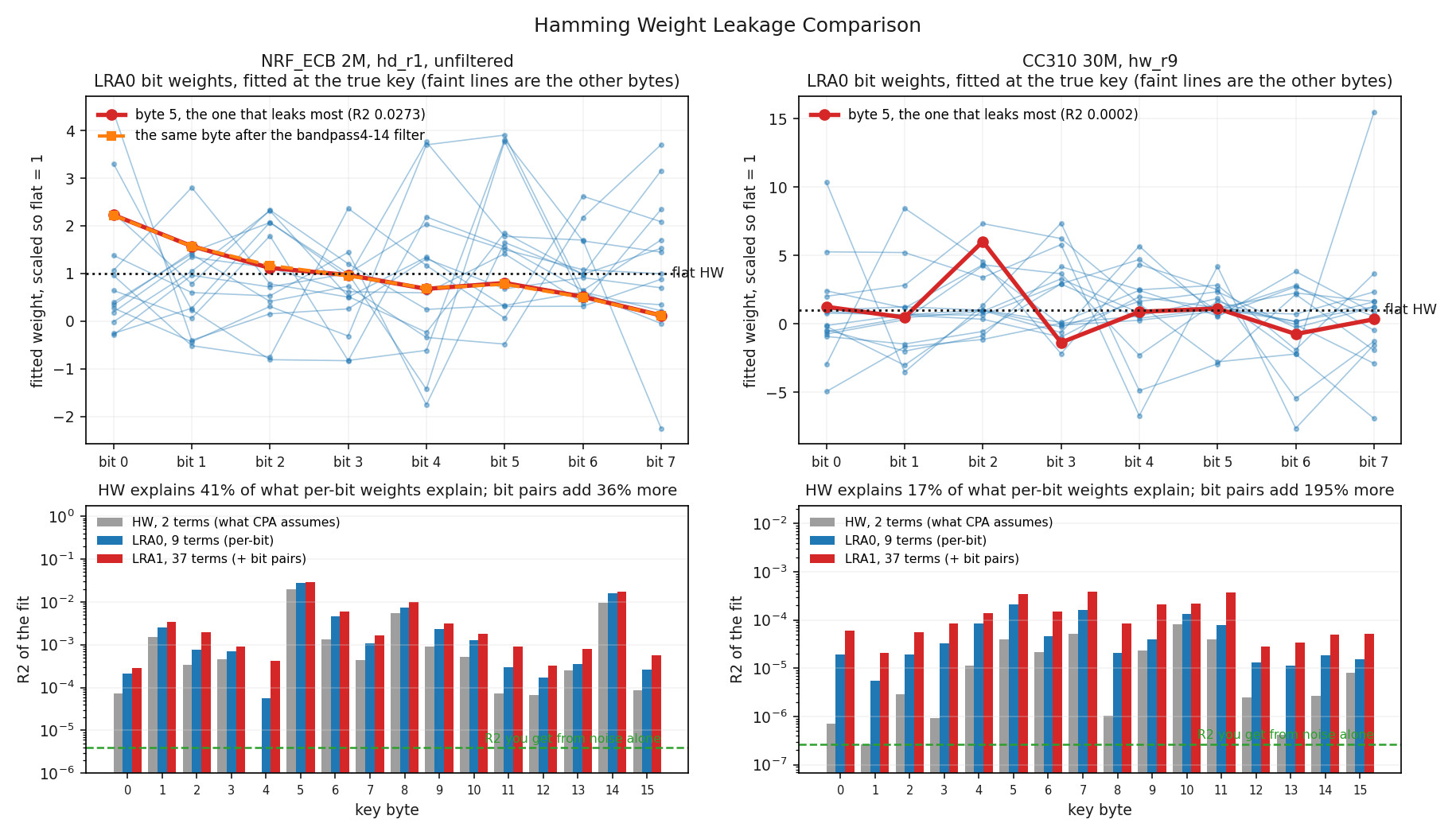
Top: the eight fitted weights per key byte, scaled so a flat Hamming weight would be a horizontal line at 1. The loudest ECB byte falls from 2.2 at bit 0 to 0.1 at bit 7, and the band-passed fit (dashed) lies on top of the unfiltered one. Bottom: Hamming weight explains 41% of what per-bit weights explain on the ECB core and 17% on the CC310, so it is the wrong yardstick on both.
The leakage genuinely isn’t Hamming-weight shaped, filtered or not. The filter doesn’t move the
fitted weights by anything you can see. What it changes is which distinguisher wins, which is
a different question, and the parameter counts are the way in. Correlation is a
straight-line fit: computing r between a trace sample and HW(guess) is the same thing as
fitting trace = a + b x HW(v), which is two free numbers, an offset and a scale. LRA throws
out the fixed shape and fits a + w0 x bit0 + ... + w7 x bit7 instead, nine free numbers, and
the bit-pair version adds all 28 products of pairs of bits for 37. They’re nested, so CPA is
just LRA with all eight weights forced equal to each other.
Every one of those free numbers gets fitted from noisy data, which means every one also hands the 255 wrong key guesses more room to fit noise and look plausible. Out of an R2 of 0.03 there isn’t much signal to buy and the extra variance costs more than the model error it removes. On the ECB core, filtered, the ranking runs straight down the parameter count, 16/16 then 14/16 then 12/16, exactly opposite to how well each one fits. So a distinguisher comparison measures the model and the parameter count together, and we’d both taken it as measuring the model.
Number 3 is a fairly classic mistake that many humans have made. The 39-bit gap wasn’t evidence about phase, because the two captures used different random keys as well, so nothing in them separates the two effects. Those two captures’ median |r| really does differ 2.60x, but run three different random keys on the ECB core, where the measurement is clean, and the medians come out 0.0211, 0.0200 and 0.0190, inside 11% of each other, while the spread within each capture is 35x to 55x. The key moves which byte is loud, not how loud the set is. The honest version is that the experiment was confounded and it reached for the explanation that was easiest to live with.
Normally in side-channel work we try running many keys to generalize results, as this problem is well known. Research papers that don’t average results over multiple keys often get this flagged in peer review (or should get it flagged), so it was interesting (terrifying?) to see Claude make the same sort of “basic research mistake”. To some degree I wonder how much it’s learned from our own bad practices.
What settled the phase question was nine repeats of one identical configuration:
45.7 54.8 52.9 50.7 55.6 53.8 50.7 48.8 50.0 -> mean 51.4, sigma 3.15 (CV 6.1%)
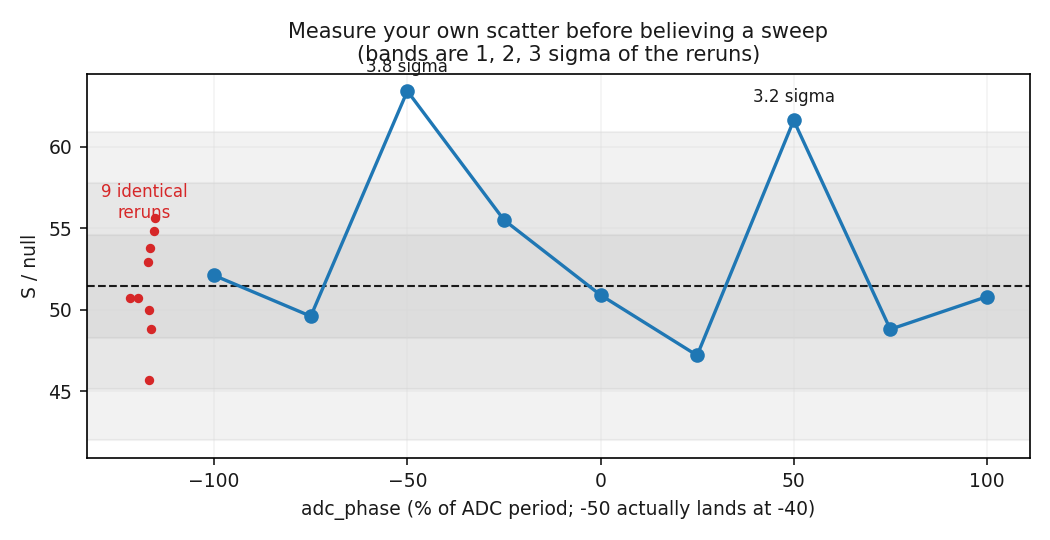
The sweep against the scatter of nine reruns of one configuration. Both of the phase results I’d been chasing sit inside two sigma of doing nothing at all.
Six percent. Nothing under about 10% was ever interpretable, which means the first two phase
results weren’t evidence of anything. Rate does matter (adc_mul=4, two samples per core
cycle, is 3.5-8.9 sigma better than every other setting, and odd multipliers are worst because
the sampling grid drifts against the core clock), but it had been chasing an effect the same
size as the bench’s own scatter for about two hours before anyone measured that scatter.
This sort of “jumping to conclusions” transcends security research, and apparently transcends human researchers as well.
False Starts and Early Failures
The retractions above are the interesting failures. Most of what went wrong was duller than that, and since the point of writing this up is to show what using an agent on a bench actually looks like, here’s the other half.
It didn’t even get the day started on the first go. The very first attempt, at 10:49, found the
Husky, found the empty project folder, and then ran find "D:/" -maxdepth 4 -iname hal across a
Dropbox-synced drive (which triggers a bunch of syncs!). I killed it about seventy seconds in and
started over, which is why there’s a prompt early on pointing it at the submodule by hand.
Things that got built, run, and went nowhere:
- Hamming weight on the ECB core’s round states. Nothing at all. The staircase only shows up under Hamming distance between consecutive rounds, which is the tell that you’re watching a register get overwritten rather than logic settle.
- Every last-round model on the ECB core (
hw_r9,hd_same,hd_sr,hd_isr), all at or under 0.006, so noise. The two ShiftRows pairings were kept on purpose as controls, so a pairing couldn’t be claimed unless the other one scored worse. clock_ladder.py, asking whether the HFXO will lock off 32 MHz and whether that buys any SNR. Written, run, never cited in a result. Still in the repo.- CPA on the CC310, at any trace count, with any filter. Best it ever managed was 9/16 and 2^69.5. That core only goes to LRA.
- TVLA on the CC310, which is the ‘gotcha’ I’d most like people to take away. |t| = 2425 with 1284 of 1500 samples over threshold looks like a catastrophic leak and means almost nothing, because with a fixed plaintext every intermediate is fixed too. Run on the ECB core as a positive control it gives 2006, so the test can’t tell the two cores apart either.
- About two hours on sampling phase, as above, net effect zero.
A number of mistakes were made within Claude running commands (what it calls “the plumbing”).
A \n eaten by a non-raw
Windows path string. Argparse reading -100,-75,... as a flag, which killed the phase sweep
instantly at 16:18 and got reported to me as “running” until 17:29, so nothing was capturing for
those minutes. Two jobs holding about 8 GB each until the machine ran out of memory, which
killed a filter sweep at 11:43 that wasn’t noticed until 15:01. A sleep 60 then tail pattern
the harness refuses outright.
The bench problems it handled well and mostly first time, because it went to the netlist, the schematic and the ARM core manual instead of guessing. The interpretation problems it was loud and useful about, which is the retraction list above. The plumbing problems are where an agent is genuinely worse than a person sitting at the same desk, because every one of them failed silently. Nothing crashed in a way I could see, and the wrong answer was always “it’s running, give it twenty minutes”. Eventually when I probed it further it would detect the missing result.
Nearly Published Mistakes
Making the figures for this post turned into an error-finding exercise (not fully expected). Generating graphs from some of the data shook out other problems. Everything in this list was sitting in the draft or in the project README at some point, and all of it is corrected above:
- The CC310 window table said “whole window, 2 M traces, 0/16 bytes, 2^128”. It doesn’t reproduce, and it couldn’t have: there is no 2 M by 1500-sample capture on disk. The 2^128 is the 500k whole-window run filed under the wrong trace count. Leaving the read-back in really costs about 13 bits.
- Retraction 2 said a band-pass showed the ECB leakage was Hamming-weight shaped after all. Fitting the eight bit weights says otherwise, and the filter doesn’t move those weights at all.
- “The two keys’ median |r| differed 2.7x” is a real number with the wrong story attached to it.
- A figure caption claimed the cipher was 12% of the window. Measured, it’s 6%. It had written that one from a half-remembered line in the README rather than from the profile the figure was supposed to describe.
- Another figure’s shaded regions were a reading of the README prose rather than anything derived. They’re now boundaries off the correlation and NICV profiles.
- The NICV floor figure labelled round 1 as the strongest round. It’s third. Round 6 is the strongest and it’s twice round 1 (no idea where this came from).
Two of these got caught the same way, I looked at a picture and something in it didn’t match the text next to it. The 486 against 716 cycles was written down and read as one core being slower than the other, and drawn to scale with the AES marked on each you can see the two ciphers are nearly the same width and the whole difference is wrapper. No amount of re-reading the sentence would have got me there.
How many other errors are in the figures & write-ups above still? A good question, but beyond what I have time to answer now.
Nine Hours with $100 of Opus 5 Credit
The initial session was 8 h 55 m wall clock, and that number is mostly the human (me) being lazy.
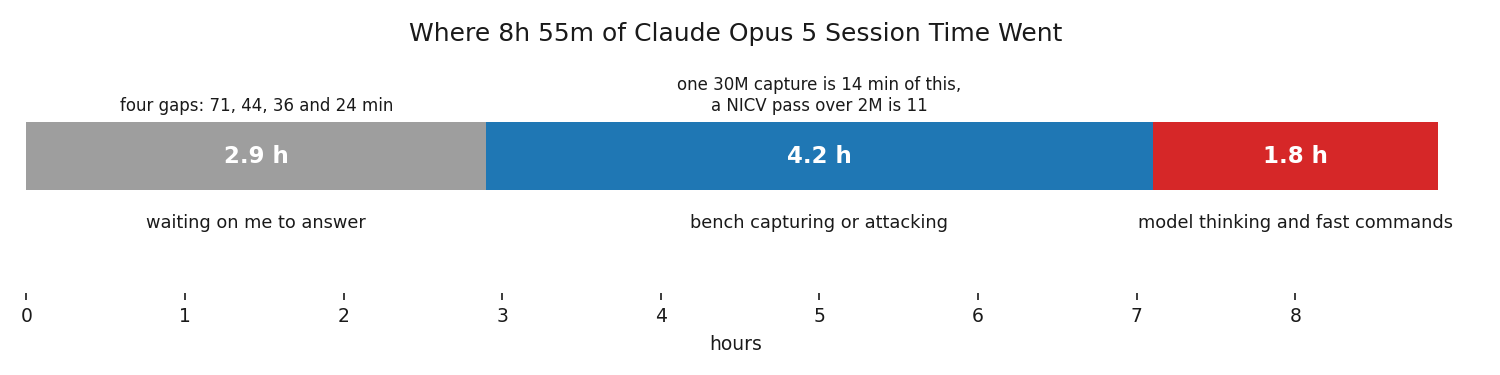
About a third of it is the session sitting idle waiting for me to reply, which is the entire point of driving it from a phone.
The 2.9 hours is four gaps of 71, 44, 36 and 24 minutes where it had finished and was waiting on a reply from me. I was doing other things, which is the entire point of driving it from a phone. Of the bench time, one 30 M capture is 14 minutes on its own and a NICV pass over 2 M traces was 11.
So: about 6 hours if I’d been answering instantly, and about an hour to reproduce it now that the recipes are written down. 14 minutes of that is the 30 M capture, 11 the NICV, and the rest is build, flash, verify, the ECB attack at 90 seconds, and the filter sweep. The discovery is what costs; the attack is cheap.
Model cost for the day was $99.40 (estimated as ran from my subscription), all Opus 5, 390k output tokens of which 180k was thinking, and 157 million cached input tokens read. 306 shell commands, 217 lines of code written, 36 scripts on disk at the end. The November pass that produced most of the figures above and both of the corrections needed one new capture, eight minutes of bench time for the block-divergence run. Everything else came back out of the 24 GB that was already sitting on the disk from September, which is its own argument for keeping the traces.
Conclusions
Both hardware AES cores on the nRF52840 are unprotected AES with a noisy neighbour, and both
come out with a filtered correlation attack: 2^0 on NRF_ECB from 90 seconds of capture, 2^8.9
on the CryptoCell CC310 from 14 minutes. Neither is a remote attack - this is a modified board
on a bench with the ChipWhisperer supplying the target’s clock - so don’t read it as a BLE
break.
The part I didn’t expect is how little of my day it took, and that the useful human contributions were a pointer at the right submodule, a soldering iron, and couple quasi-technical comments.
An interesting question is while I’m upfront in this post about what Claude did & what I did, you could easily re-write this as a fairly substantial research project. It does mean we need to reconsider what makes for “useful” research to some degree, and perhaps really it just means we must raise the bar on interesting results.
I have not yet released the full project but will update this when I do. In the meantime, consider doing your own beachdpa work to break some hardware crypto from anywhere.